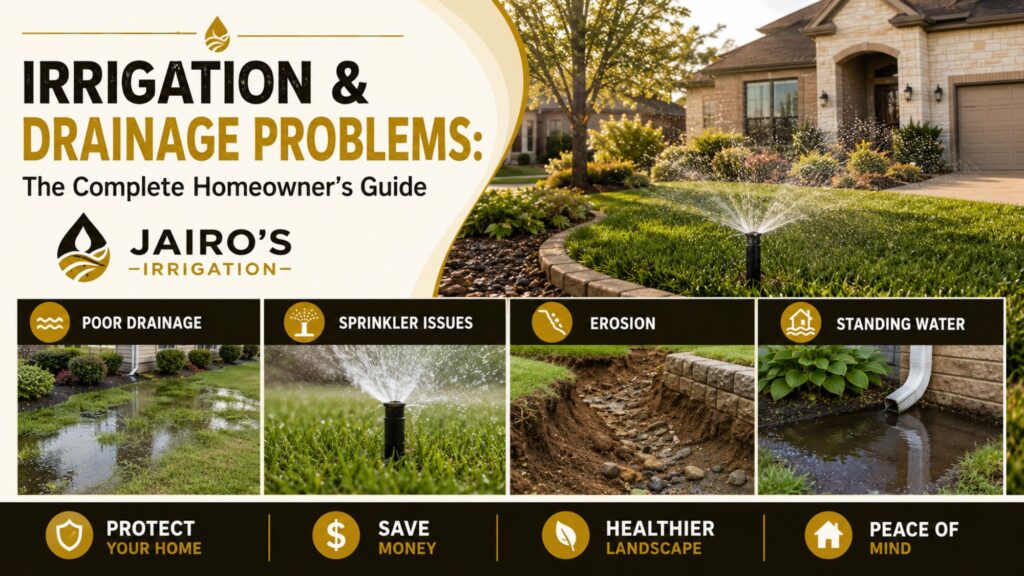
You’ve got a soggy yard that won’t dry out. Or maybe water pools near your foundation every time the sprinklers run. You’re not sure if you need irrigation repair or drainage work — and you’re worried about spending money on the wrong fix.
Here’s the truth: most Coppell homeowners deal with both issues simultaneously, and fixing only one leaves the problem half-solved. This guide walks you through how to identify what’s actually broken, what each type of repair costs, and why North Texas clay soil makes these problems particularly destructive to foundations.
You’ll leave this page knowing exactly what questions to ask contractors, which problems demand immediate action, and how to avoid the $8,000+ foundation repair bills that follow years of ignored drainage issues.
Table of Contents
- → Which Type of Homeowner Are You?
- → Irrigation vs. Drainage: How to Tell the Difference
- → 7 Warning Signs Your Problem Is Getting Worse
- → What It Actually Costs to Fix in Coppell
- → How Drainage Problems Destroy Foundations
- → Which Solution Is Right for Your Property
- → What to Expect: Diagnosis to Completion
- → Frequently Asked Questions
Which Type of Homeowner Are You?
Your situation determines which sections you should focus on first. Pick the scenario that matches your current frustration:
The “Soggy Yard” Homeowner
Your yard stays wet for days after rain or irrigation. You see standing water, muddy patches, or erosion channels forming near your home.
Focus on: Warning Signs, Foundation Damage, Drainage Solutions
The “Foundation Worrier”
You’ve noticed cracks in walls, doors that stick, or gaps between trim and ceiling. Water pools within 5 feet of your foundation.
Focus on: Foundation Damage, Cost Breakdown, Timeline
The “Bad Sprinkler System” Owner
Some zones work, others don’t. You’ve got dry spots and soaked spots in the same yard. Your water bill is climbing but the grass isn’t improving.
Focus on: Irrigation vs. Drainage, Cost Breakdown, Solutions
Irrigation vs. Drainage: How to Tell the Difference
Here’s the confusion that costs Coppell homeowners thousands: standing water doesn’t automatically mean your sprinkler system is overwatering. It often means water has nowhere to go once it hits the ground.
The fastest way to tell: turn off your irrigation system completely for 3 days. If problem areas still pool after the next rain, you’ve confirmed a drainage issue, not an irrigation problem.
Signs It’s an Irrigation Problem
- Dry spots with brown grass despite regular watering
- Uneven coverage — some areas soaked, others dry
- Low water pressure in specific zones
- Visible geysers or broken sprinkler heads
- Controller won’t start or runs erratically
- Water only pools while sprinklers are running
Signs It’s a Drainage Problem
- Standing water that persists 6+ hours after irrigation stops
- Soggy patches even when sprinklers are off for days
- Water pooling after rain, not just irrigation
- Erosion channels forming near foundation or slopes
- Basement or crawl space moisture issues
- Water stains on foundation or exterior walls
⚠️ Common Trap: Many homeowners reduce irrigation run times thinking that will solve standing water. If the real issue is poor drainage, you’ll end up with a soggy yard and dead grass. Fix the drainage first, then optimize irrigation.
7 Warning Signs Your Problem Is Getting Worse
Most Coppell homeowners wait too long to address irrigation and drainage issues because the damage happens gradually. Here are the escalation signals that mean you’re past the “minor annoyance” stage:
🚩 Mosquito Breeding Zones
Standing water for 3+ days creates mosquito habitat. If you’re suddenly dealing with swarms, you’ve got drainage failure.
🚩 Soil Erosion Channels
Water carving visible paths through your yard means concentrated flow is washing away topsoil — and undermining structures.
🚩 Water Bill Climbing
If your water usage jumped 20%+ without explanation, you likely have underground irrigation leaks feeding the drainage problem.
🚩 Neighbor Complaints
Water draining onto adjacent properties can lead to liability issues if it damages their landscaping or foundation.
🚩 Dead Grass in Wet Areas
Grass drowning from root rot indicates chronic saturation. The turf is already dead — the soil structure is being destroyed next.
If you’re seeing 3 or more of these signs, you’re past the “wait and see” stage. The longer water sits against your foundation or pools in your yard, the more expensive the eventual fix becomes.
What It Actually Costs to Fix in Coppell
Here’s what irrigation and drainage repairs cost in the Coppell market as of 2025. These are not national averages — these reflect actual North Texas labor rates, material costs, and soil conditions.
Irrigation Repair Costs
Basic Repairs
$175–$450
- Controller programming or replacement
- Valve repair or replacement (1-2 valves)
- Sprinkler head adjustments or replacements
- Rain sensor installation
Zone Replacement
$850–$1,800
- Full zone piping replacement
- Multiple valve replacements
- Backflow preventer repair
- Underground leak repair with trenching
System Overhaul
$3,200–$7,500
- Complete system redesign
- Smart controller with WiFi integration
- Conversion to high-efficiency nozzles
- Drip irrigation for beds and foundation zones
Drainage Solution Costs
French Drain
$1,200–$2,800
For 30-50 linear feet
- Perforated pipe in gravel trench
- Ideal for yard-wide saturation
- Routes water to street or drainage easement
Catch Basin System
$800–$1,600
Per basin installed
- Collects surface water in low spots
- Connects to underground drainage pipe
- Best for localized pooling
Yard Regrading
$2,500–$6,500
Depending on scope
- Reshaping yard slope for proper drainage
- Adding soil to create positive grade away from home
- Often combined with French drains
Foundation Drainage
$3,800–$7,200
Full perimeter protection
- French drain around entire foundation
- Protects against expansive clay movement
- Often required before foundation repair warranty
What Pushes Cost UP ↑
- Hard clay soil requiring excavation equipment
- Existing hardscape (patios, walkways) in the way
- Deep trenching for proper slope
- Long pipe runs to reach drainage outlet
- Multiple problem areas across large property
What Keeps Cost DOWN ↓
- Clear access to problem areas
- Localized issue vs. property-wide saturation
- Street drainage outlet available nearby
- Minimal landscaping restoration needed
- Addressing problem before foundation damage
Average Coppell project combining irrigation repair and drainage work: $4,200–$8,500. This typically includes fixing broken irrigation zones, installing a French drain system, and regrading problem areas. The alternative — ignoring it until foundation repair is required — averages $8,000–$15,000 just for the foundation work, plus you still need drainage correction.
How Drainage Problems Destroy Foundations in North Texas
This section matters more than any other if you own a home in Coppell. Our expansive clay soil doesn’t forgive poor drainage. It actively punishes it.
Here’s the cycle that creates $10,000+ foundation repair bills:
The North Texas Foundation Damage Cycle
Stage 1: Water accumulates near foundation
Poor drainage or overwatering from irrigation creates standing water within 5 feet of your home’s perimeter. Most homeowners notice soggy ground but assume it’s harmless.
Stage 2: Clay soil expands
North Texas clay contains minerals (smectite) that absorb water and expand significantly. The soil swells, pushing upward and laterally against your foundation with thousands of pounds of force.
Stage 3: Soil dries and contracts
When water drains or evaporates, the clay shrinks rapidly, pulling away from the foundation and creating gaps and voids underneath the slab. Your foundation now has inconsistent support.
Stage 4: Foundation settles unevenly
Areas with voids beneath them settle while other sections remain supported. This differential movement causes the cracking, tilting, and structural damage you see inside your home.
Stage 5: The cycle repeats and worsens
Every wet-dry cycle expands existing cracks, creates new voids, and accelerates damage. What started as a minor drainage issue becomes a structural crisis requiring engineering intervention.
🚨 Critical Fact: Most foundation repair companies in Coppell will NOT warranty their work unless you install proper drainage first. They know that without controlling water, the foundation will move again and their repairs will fail. You’ll pay for foundation repair twice if you skip drainage correction.
Visible Signs Foundation Damage Has Started
- Interior cracks: Diagonal cracks above doors/windows, stair-step cracks in brick, vertical cracks in drywall at corners
- Gaps: Separation between wall and ceiling, between wall and floor trim, between exterior walls and brick veneer
- Doors and windows: Suddenly sticking, won’t latch, gaps visible when closed, or won’t stay open on their own
- Uneven floors: Visible slope, marbles roll in certain directions, furniture sits uneven
- Exterior brick: Cracks forming in mortar joints, entire brick faces cracking, rotation or bulging in sections
- Water intrusion: Basement moisture, crawl space flooding, or slab cracks allowing water into interior spaces
If you’re seeing any of these symptoms combined with drainage issues, you need both drainage correction and foundation inspection — in that order. The drainage must be fixed to stop ongoing damage before foundation work makes sense.
Which Solution Is Right for Your Property
Not every drainage problem requires the most expensive solution. Here’s how to match the fix to your specific situation based on where water pools, how quickly it drains, and what structures are threatened.
French Drain System
Best for: Property-wide saturation, water that won’t drain naturally, protecting foundation perimeter
How it works: Perforated pipe buried in a gravel-filled trench collects groundwater and routes it away from problem areas to a drainage outlet.
Installation: 1-3 days depending on length. Requires trenching 18-24 inches deep with proper slope to outlet.
Catch Basin + Underground Pipe
Best for: Localized pooling in low spots, surface water collection, areas where regrading isn’t possible
How it works: Grated basin collects surface water and funnels it into underground drainage pipe running to street or easement.
Installation: 1 day per basin. Works best when combined with proper yard grading.
Yard Regrading
Best for: Properties with negative slope toward house, newly built homes with poor original grading
How it works: Adding or removing soil to create positive slope away from structures, ideally 6 inches of drop over 10 feet.
Installation: 2-5 days depending on scope. Often requires sod or seed restoration after grading.
Channel Drain / Trench Drain
Best for: Water flowing across driveways, patios, or hardscape; controlling sheet flow from slopes
How it works: Linear grated drain installed in concrete or pavers intercepts flowing water before it reaches problem areas.
Installation: 1-2 days. Requires cutting into existing hardscape and connecting to drainage pipe.
Dry Creek Bed
Best for: Properties with visible erosion channels, areas where you want drainage that doubles as landscape feature
How it works: River rock-filled swale guides water flow while looking like intentional landscaping. Can include underground pipe beneath rock.
Installation: 2-4 days. More aesthetic than functional systems but still effective for moderate flow.
Complete Drainage + Irrigation Redesign
Best for: Properties where both systems are failing, homes with foundation concerns, clients wanting permanent solution
How it works: Coordinated approach fixing irrigation overwatering issues while installing comprehensive drainage to handle both irrigation and rainfall.
Installation: 5-10 days. Includes smart irrigation controller, drip zones near foundation, French drains, regrading, and catch basins as needed.
💡 Pro Tip: The most effective drainage solutions in Coppell combine multiple approaches. A French drain around the foundation perimeter paired with catch basins in low spots and regrading near the house provides redundant protection. Water always finds a way — give it multiple exit paths.
What to Expect: Diagnosis to Completion
Here’s the realistic timeline for fixing irrigation and drainage problems in Coppell, from the moment you contact a contractor to the day you’ve got a dry, functional yard.
Day 1
Initial Contact
Call or submit contact form. Good contractors respond same day with available assessment times.
Days 2-3
On-Site Assessment
45-90 minute property walk-through. Testing irrigation zones, identifying drainage flow patterns, checking foundation areas.
Days 3-5
Proposal Delivery
Detailed quote with scope, timeline, and cost breakdown. Quality contractors include photos and specific recommendations.
Week 2
Work Begins
After approval, crew schedules installation. Most Coppell drainage projects: 3-7 days. Irrigation repairs: 1-3 days.
Week 3
Testing & Adjustment
System testing during next rain or irrigation cycle. Adjustments to flow, slope, or coverage as needed.
Total time from first call to completed project: 2-4 weeks for most Coppell properties. Emergency irrigation repairs can be completed same-week. Comprehensive drainage overhauls may extend to 6 weeks if foundation work or extensive landscaping restoration is required.
⚠️ Seasonal Considerations: Spring (March-May) is the busiest season for drainage work in North Texas. Expect longer scheduling windows. Late fall (October-November) offers fastest turnaround and lets systems prove themselves during winter rains before summer heat arrives.
Frequently Asked Questions
How do I know if my sprinkler problem is actually a drainage problem?
Standing water that persists for 6+ hours after irrigation shuts off typically indicates a drainage issue, not just overwatering. If you notice soggy patches with visible pooling even when sprinklers are working properly, erosion channels forming near foundation areas, or water stains on your foundation within 3-5 feet of problem areas, you’re dealing with drainage failure.
True irrigation problems show up as dry spots, uneven coverage, or pressure issues — not chronic standing water. The test: turn your irrigation system off completely for 3 days. If problem areas still pool after the next rain, you’ve confirmed drainage is the culprit.
What does it cost to fix irrigation vs. drainage issues in North Texas?
Basic irrigation repairs in Coppell (valve replacement, head adjustments, controller programming) typically run $175-$450. Full zone replacements range $850-$1,800.
Drainage solutions vary significantly: French drains start at $1,200-$2,800 for 30-50 linear feet, catch basin installations run $800-$1,600 per basin, and comprehensive yard grading projects range $2,500-$6,500 depending on scope. Foundation drainage systems protecting your home’s perimeter start at $3,800-$7,200. Most Coppell homeowners addressing both issues together invest $4,200-$8,500 total.
Can a bad drainage system damage my home’s foundation?
Yes, absolutely. In North Texas expansive clay soils, standing water near your foundation causes the clay to expand, pushing against foundation walls. When the soil dries, it contracts and pulls away, creating gaps and voids.
This cycle of expansion and contraction leads to foundation movement, visible cracks in walls and floors, sticking doors and windows, and separation between walls and ceiling. Most foundation repair companies in Coppell require drainage correction before they’ll warranty their work, because without proper drainage, foundation repairs will fail.
Average cost to repair foundation damage caused by drainage problems: $8,000-$15,000, plus you still need to fix the drainage. Addressing drainage proactively costs $3,000-$7,000 and prevents the foundation damage entirely.
Will a French drain work in North Texas clay soil?
Yes, when installed correctly. The key in clay soil is proper excavation depth (minimum 18-24 inches), adequate gravel backfill, and consistent slope to the outlet. Clay’s poor drainage is exactly why French drains work — they create a path of least resistance through gravel, intercepting water before it saturates the clay.
However, French drains in clay require fabric liner to prevent clay particles from migrating into the gravel and clogging the system over time. Quality installations also include cleanout access points so the system can be flushed if sediment accumulates. Expect French drains in Coppell clay to cost 15-25% more than in sandy/loamy soils due to excavation difficulty.
How long do drainage solutions last?
Properly installed drainage systems in North Texas typically last 15-25 years. French drains with quality pipe and fabric can function for 20+ years. Catch basins and channel drains, being simpler with fewer components, often outlast the home itself if maintained. The main threats to longevity: tree root intrusion (particularly from willows, pecans), sediment buildup in pipes, and soil settlement changing the original slope. Annual inspection and cleanout of catch basins extends system life significantly. Most failures happen not from age but from poor installation — insufficient slope, inadequate gravel, or no fabric protection in clay soils.
Can I install drainage myself to save money?
Simple surface solutions like extending downspouts or installing small catch basins are reasonable DIY projects. Comprehensive drainage systems — French drains, regrading, foundation perimeter protection — require expertise most homeowners don’t have.
The risks of DIY drainage work in Coppell: incorrect slope leading to standing water in the drain itself, inadequate depth causing freeze damage or root intrusion, improper fabric installation allowing clay infiltration, and most critically — directing water toward your foundation instead of away from it. We see $4,000-$8,000 in corrective work regularly when homeowners attempt foundation drainage themselves. If water is threatening your foundation or you’re seeing structural damage symptoms, hire a professional. The stakes are too high for trial and error.
Should I fix irrigation or drainage first?
Fix both simultaneously if possible. Here’s why: irrigation issues often contribute to drainage problems (overwatering, broken lines, poor zone design), and drainage solutions won’t work optimally if irrigation is dumping excessive water into the system.
However, if you must prioritize, address drainage first if water is pooling near your foundation or you’re seeing foundation damage symptoms. Stop the immediate threat, then optimize irrigation. Conversely, if you have obvious irrigation failures (geysers, broken zones, controller issues) but water drains adequately after repairs, fix irrigation first to determine if drainage work is even necessary. Many Coppell properties have drainage problems that disappear once irrigation is repaired and properly programmed.
What’s the difference between surface drainage and subsurface drainage?
Surface drainage handles water that hasn’t yet soaked into the ground — using catch basins, channel drains, swales, and proper yard grading to direct runoff away from structures before it infiltrates.
Subsurface drainage addresses water that’s already in the soil — using French drains, perforated pipe, and gravel trenches to intercept groundwater and route it away underground. Most effective drainage systems in Coppell use both: surface components to handle immediate runoff from rain and irrigation, and subsurface components to manage water that’s saturated the clay soil. If you’re only addressing one type, you’re solving half the problem.
Get a Free Drainage & Irrigation Assessment
We’ll walk your property, test your irrigation system, identify drainage issues, and provide a detailed plan with transparent pricing. No pressure, no pitch — just expert guidance on protecting your home and fixing your yard problems permanently.
Serving Coppell, Lewisville, Flower Mound, and surrounding North Texas communities.
Related services: Irrigation & Sprinkler Repair | Drainage Solutions | Emergency Irrigation Repair